Hva skal man finne på en søndag formiddag? Noe av det beste for meg er å gjøre noe som involverer et kamera, enten det nå er ute eller inne. Denne gangen ble det inne. Fint lys gjennom vinduet, kjøkkenbordet ryddet og to brød står til heving. I fotoklubben har vi drevet litt med stilleben og produktfoto, så jeg har litt inspirasjon derfra. Jeg har også diverse grønnsaker i kjøleskapet, noen epler på et fat og en rosebukett i en vase. Dermet burde det være duket for et par timer med moro.
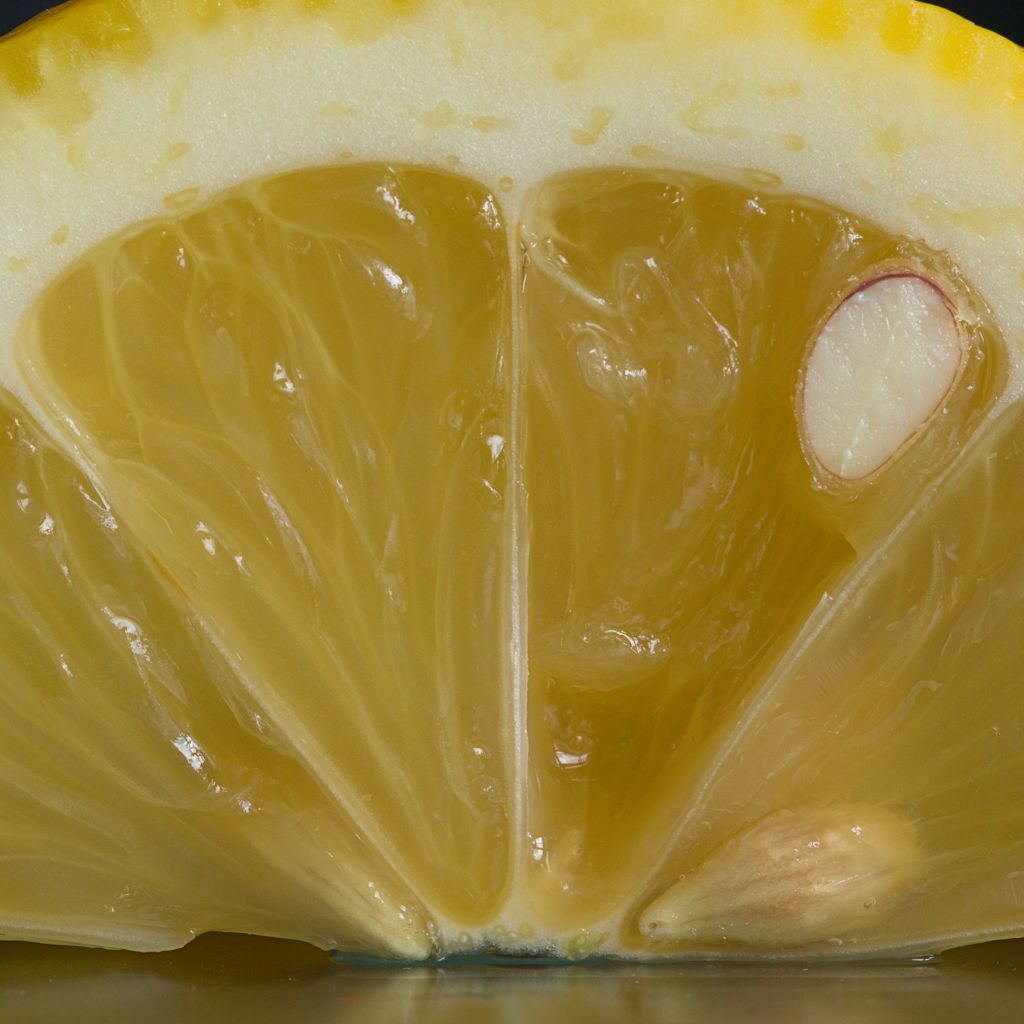
Først ut var en halv sitron som hadde sett sine beste dager. Den ble delt i to for å få et ferskt snitt og lagt på en glassplate på et svart tøystykke. Tanken var å ta nærbilder av snittflaten som fyller bildet. Hvor vellykket det var vet jeg ikke, men en fin oppvarmingsøvelse. Det mest vellykkede var nok da jeg fikk lyset fra vinduet til å skinne litt gjennom skallet.
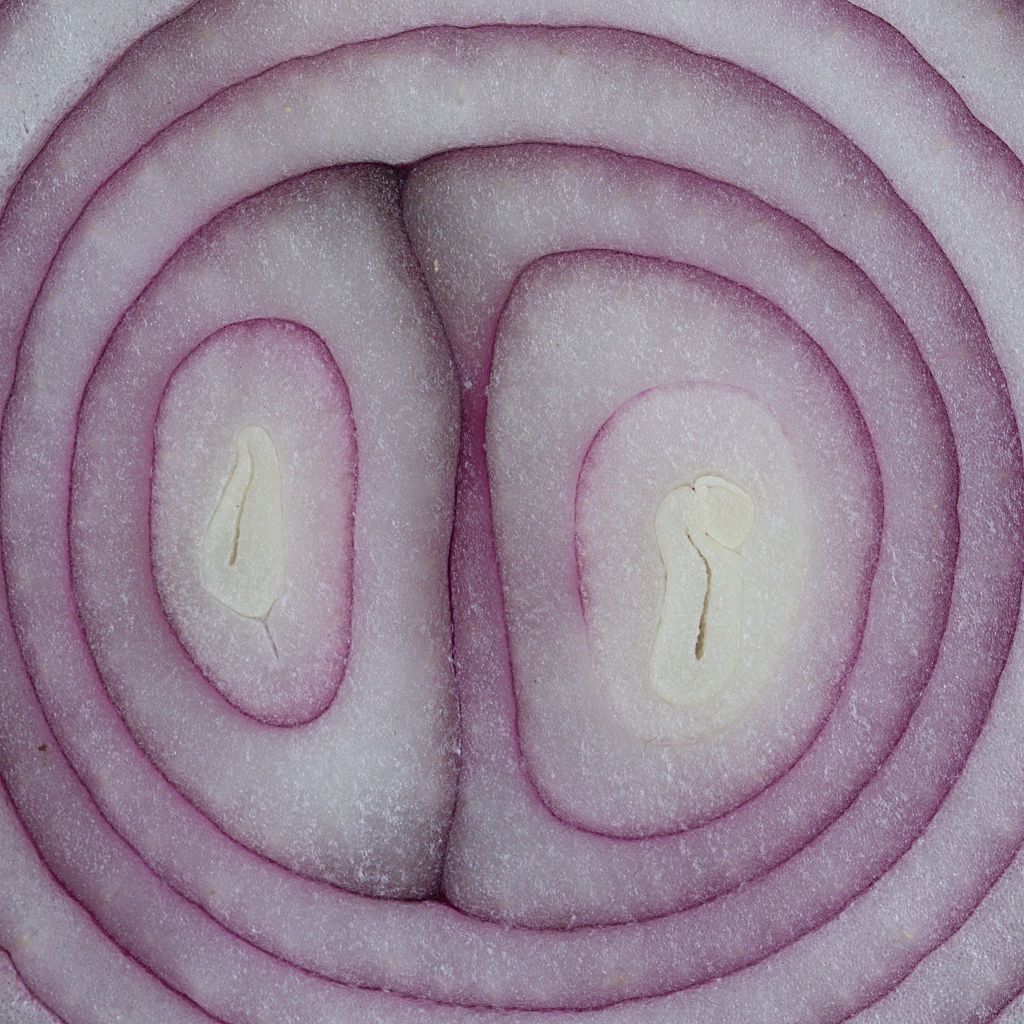
En rødløk har et tydelig og fint ringmønster som egner seg godt til et nærbilde. Dette var nok mer vellykket enn sitronen.
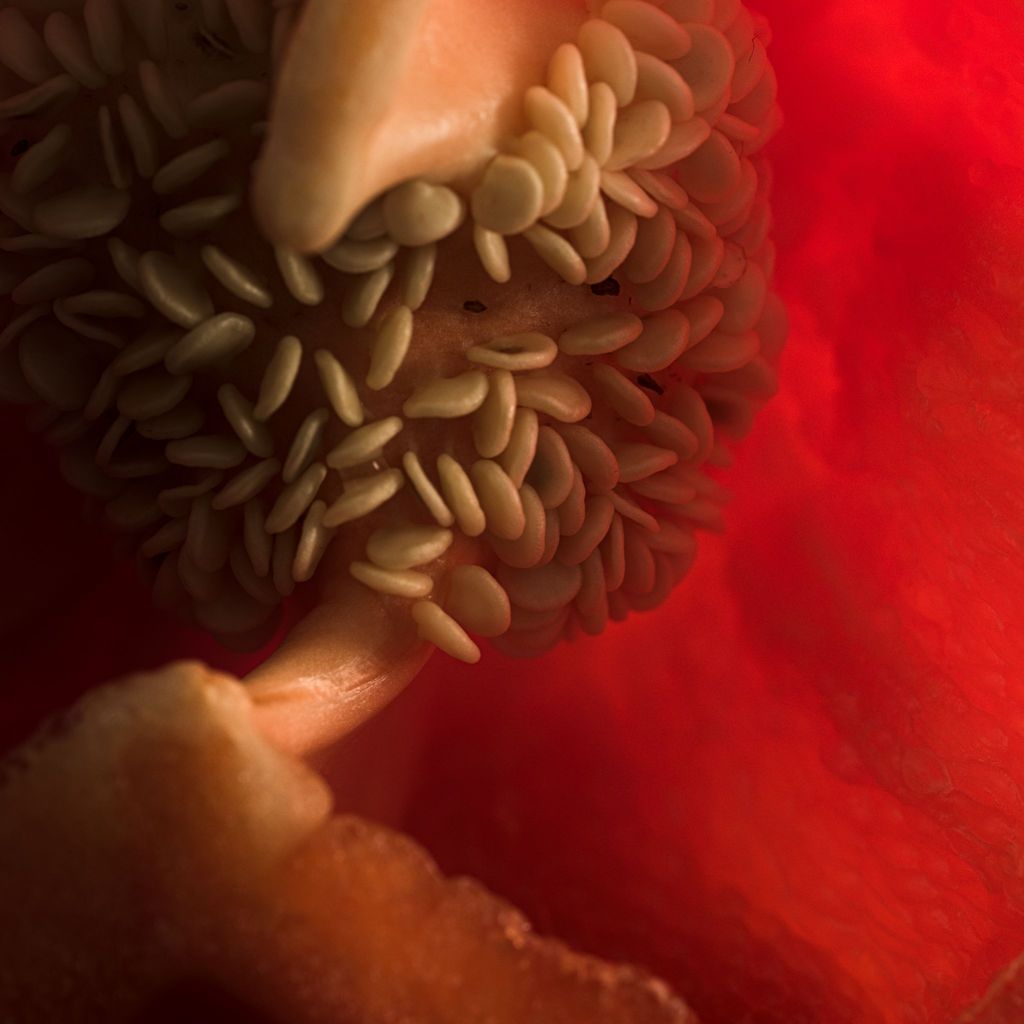
Motlys som skinner gjennom passer enda bedre på resten av en paprika. Her fikk jeg fram strukturen på innsiden av paprikaen så det røde fruktkjøttet nesten ser ut som glødende lava.
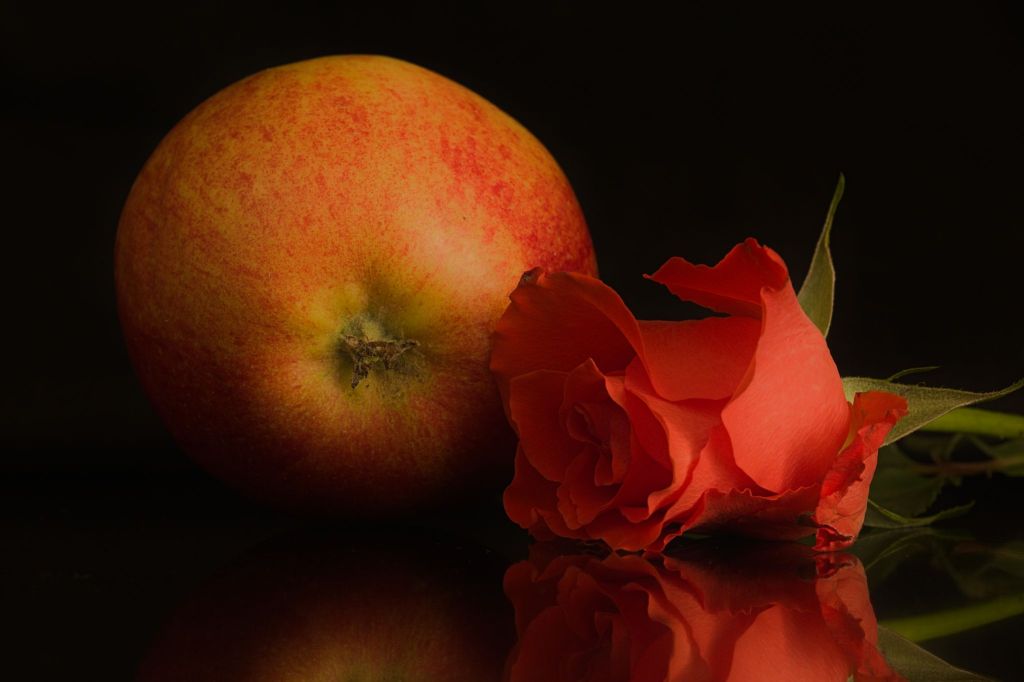
Neste forsøk er med et eple. Jeg ville helst ha skikkelig sidelys med dyp skygge på den ene siden. Dessverre var rommet for lyst til det, så et eple alene funket dårlig. Da kom jeg på å legge en rose sammen med eplet. Med svart tøy som underlag og bakgrunn ble det bedre, men så ble jeg distrahert av alarm på mobilen.
Brødene var ferdig stekt. Der er det jo også et motiv. Nybakt brød i ovnen og lagt til avkjøling på rist. Eksperimentering med ulik dybdeskarphet og litt tilbehør som smør og ost.
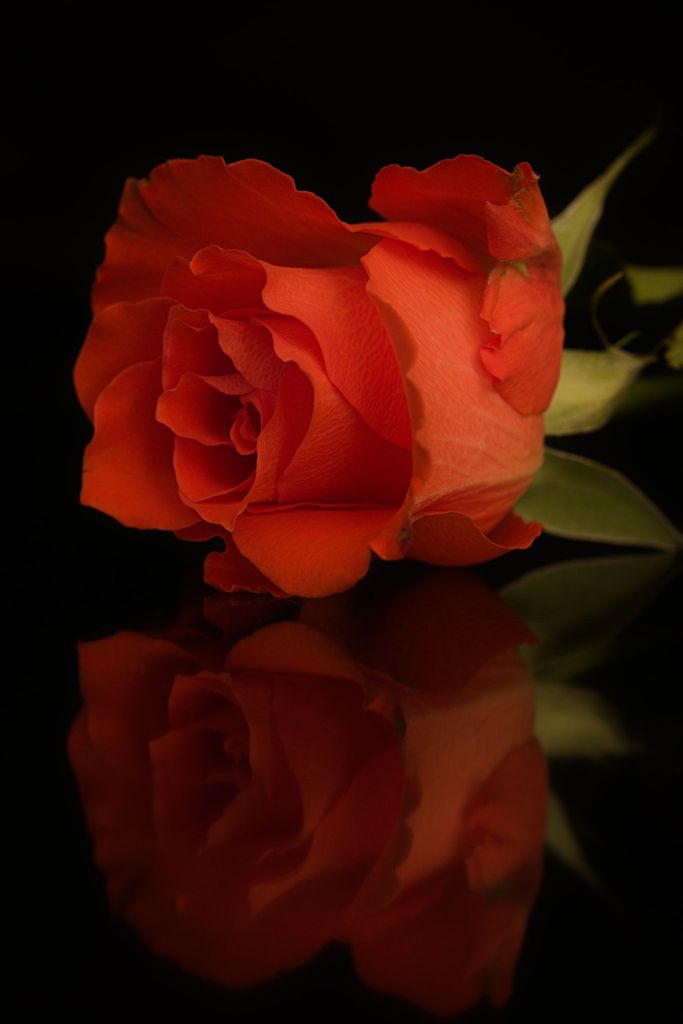
Siden jeg hadde beveget meg over til komfyren slo det meg at den keramiske toppen er jo en svart, blank glassplate. Den kan kanskje fungere til å reflektere ting som legges på. Som tenkt, så gjort. Den hvite kanten rundt komfyren, samt veggen, skjules med svart tøy. Eple og rose legges på komfyren. Lavest mulig kameravinkel og Action!
Dette ble bra. Litt forskjellige varianter prøves ut før jeg går over til bare roser. Jeg har tre forskjellige farger som jeg prøver ut enkeltvis og alle tre sammen. Det var ganske dunkelt lys ved komfyren, men det er jo ingen bevegelse i motivene og kamera står på stativ, så lukkertiden kan bli hvor lang som helst. Jeg syntes også lyset fra vinduet ga litt mye kontrast, så jeg dempet det med å holde en papplate foran. Dermed ble belysningen jevnere.
Oppsettet ved komfyren
Kamera: Canon EOS 80D Objektiv: Tamron 90 mm macro
I am lucky enough to live close to nature. A choir of birds wake me up way too early every morning at this time of the year, and if I go out for a walk, I can be surrounded by trees in no time.
So yesterday evening I grabbed my camera and my long lens and went for a little walk to see if I could get some bird photos. The sun was low and would go down in an hour or so, so I hoped for some good light on the tree tops. I walked quietly through the woods, as not to scare the birds.
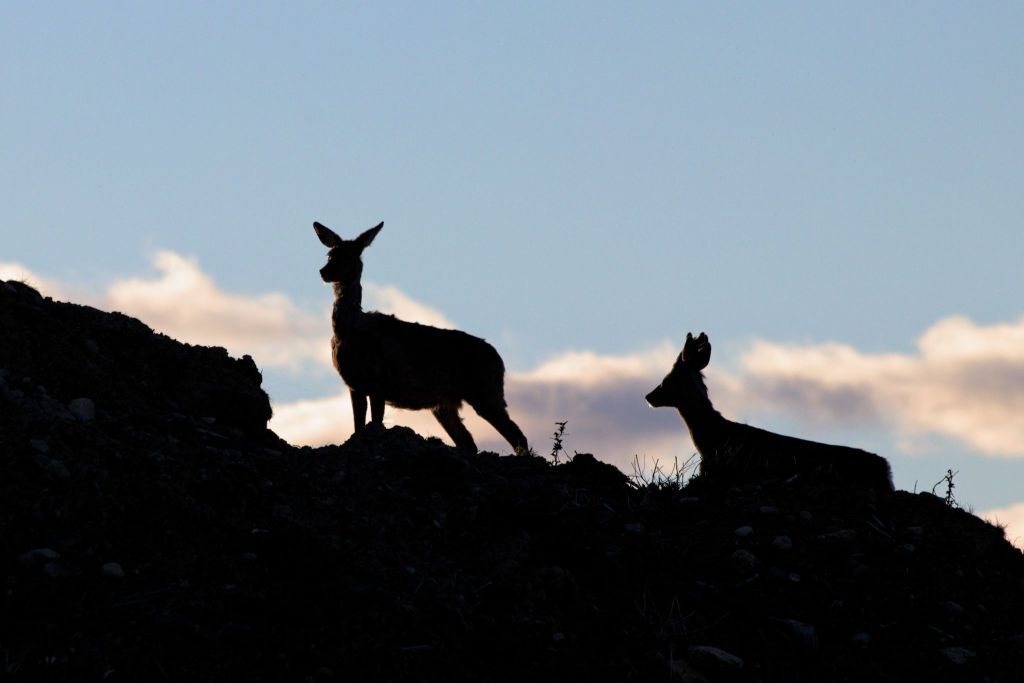
I didn’t think much of larger wildlife, but after a while I heard a sound some distance to the right and behind me. I turned around and saw two deer climbing a steep slope. I raised my camera to the eye and fired off a few shots, but as it was against the light I didn’t have much hope. Luckily, I had my camera set to Manual mode and I had already set a decent exposure. Therefore I knew it wouldn’t be too far off, even though I had set it for when I would have the light from behind. That’s the beauty of Manual.
As the deer climbed to the top of the slope, I saw them silhouetted against the sky, and I got this as my final shot of them:
Two deer. Canon 80D with Canon EF 70-300 f/3.5-5.6 IS USM @300 mm. 1/1000 s, f/8, ISO 800
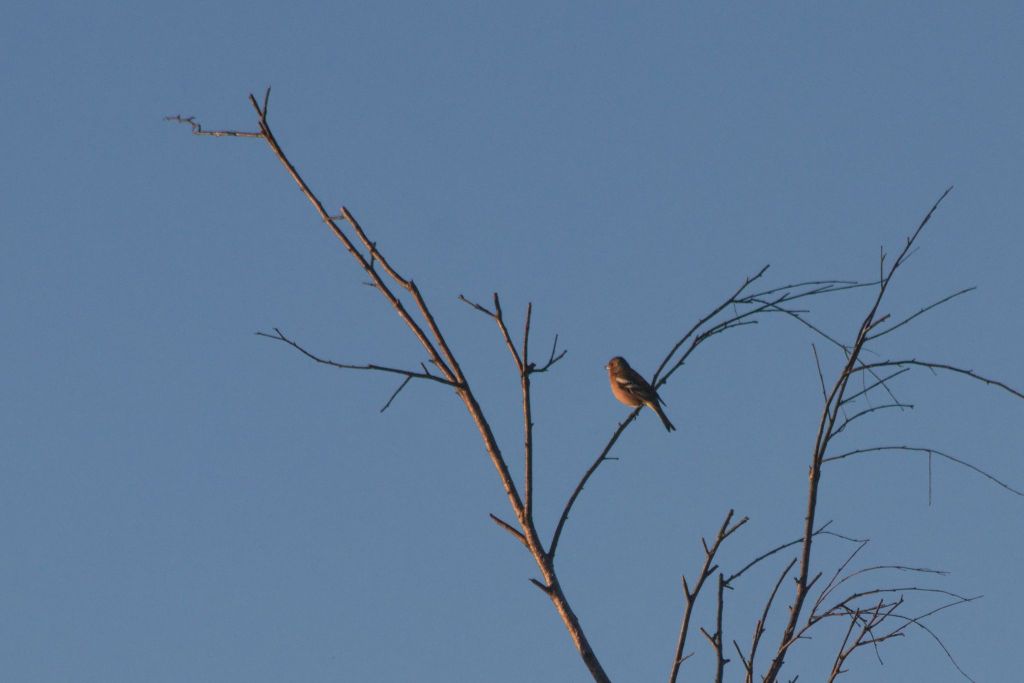
After the deer disappeared, I sat down on a rock, waiting for some birds to come by. Most of the birds around here except for magpies and crows are quite small, and my lens is only 300 mm in the long end on a crop sensor camera, so I didn’t expect to get any real close ups, as the birds are quite shy. This chaffinch is a good example of what I could expect:
Chaffinch. Canon 80D with Canon EF 70-300 f/3.5-5.6 IS USM @300 mm. 1/1000 s, f/8, ISO 800
This is also a quite heavy crop, and my lens is not the sharpest when fully zoomed in. It is still fun to go hunting, and some times unexpected things happen.
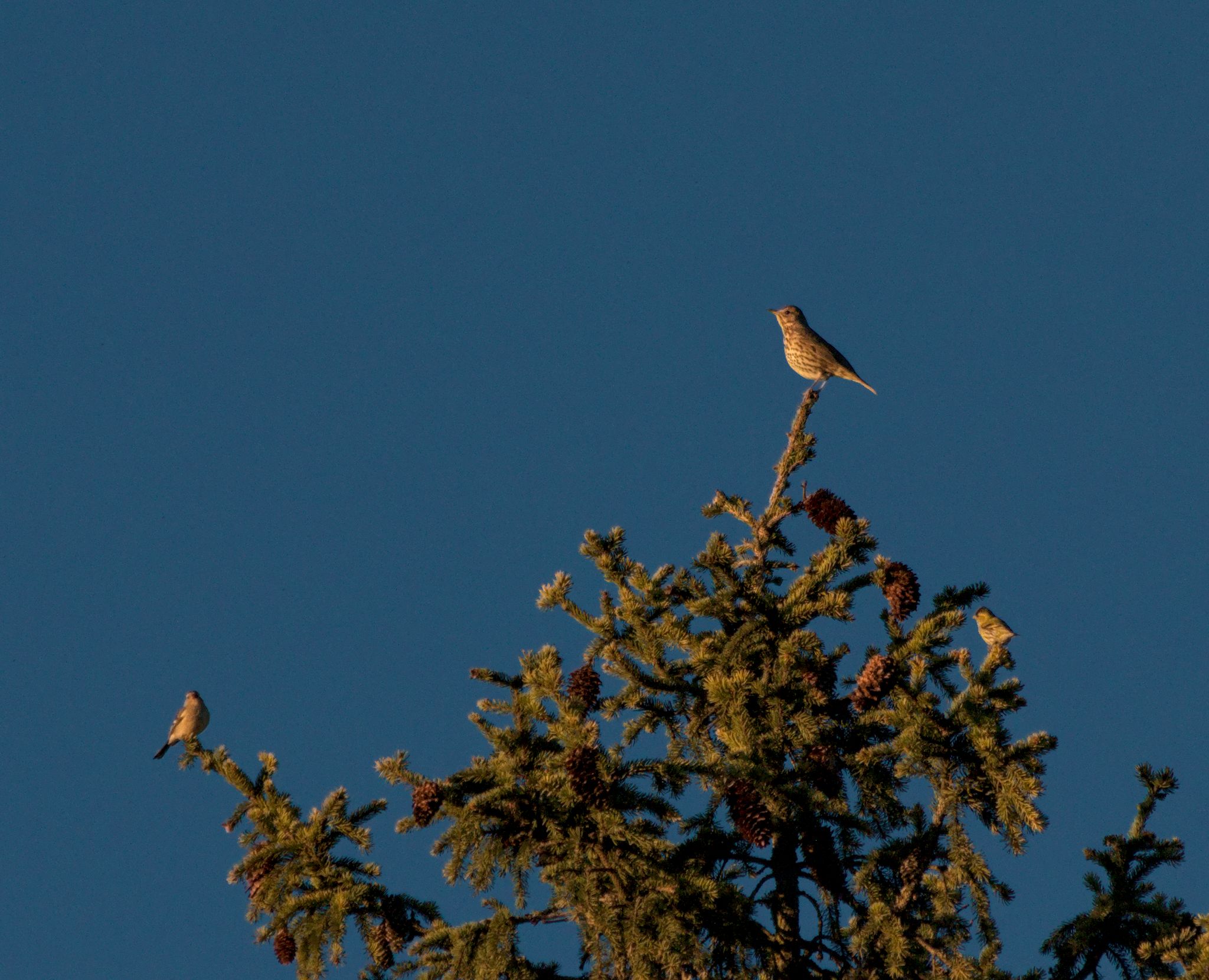
On my way back home, I spotted this bird that was sitting in the very top of a tall spruce. It was a bit larger, but I didn’t know what it was. I’m no expert on birds. It had a beautiful song and it was catching the light very well, so I took a bunch of images of it. I also saw another little bird up there that was too small to recognize.
When I got home and looked at my images on the computer an also googled a bit, I found out that the bird in the top of the tree was a song thrush (Turdus philomelos). That was very fun, because it was the first time I had seen and identified one!
The other bird I had seen up there turned out to be a chaffinch (Fringilla coelebs), and then to my surprise I noticed a third bird in the image. I didn’t know this one either, and it turned out to be a eurasian siskin (Carduelis spinus). Another first! I had never identified this one before either.
So a little walk around the neighborhood with a camera can give a lot of both exercise, exciting experiences and new knowledge. Do you have a fun experience from you local nature? Let me know down below!
From left: chaffinch, song thrush and eurasian siskin. Canon 80D with Canon EF 70-300 f/3.5-5.6 IS USM @300 mm. 1/1000 s, f/8, ISO 800
I haven’t been out taking pictures much lately, and even less showing new images to the world. Yesterday I finally pulled myself together, got up early on a Saturday and headed to a local woodland. It felt great. When I returned home after a few hours, I was refreshed and exited like I hadn’t been in months. I have had too much other stuff on my mind, so there just hasn’t been time. Or rather, I haven’t got my priorities right. I have had too much to do at work, I have spent a lot of time scanning old negatives (more on that in the next post, stay tuned!) and I am trying to sell a house in a slow market.
But after yesterday, I decided that I need to do more of all the things I want to do but postpone all the time:
So what was the outcome of yesterday’s little adventure?
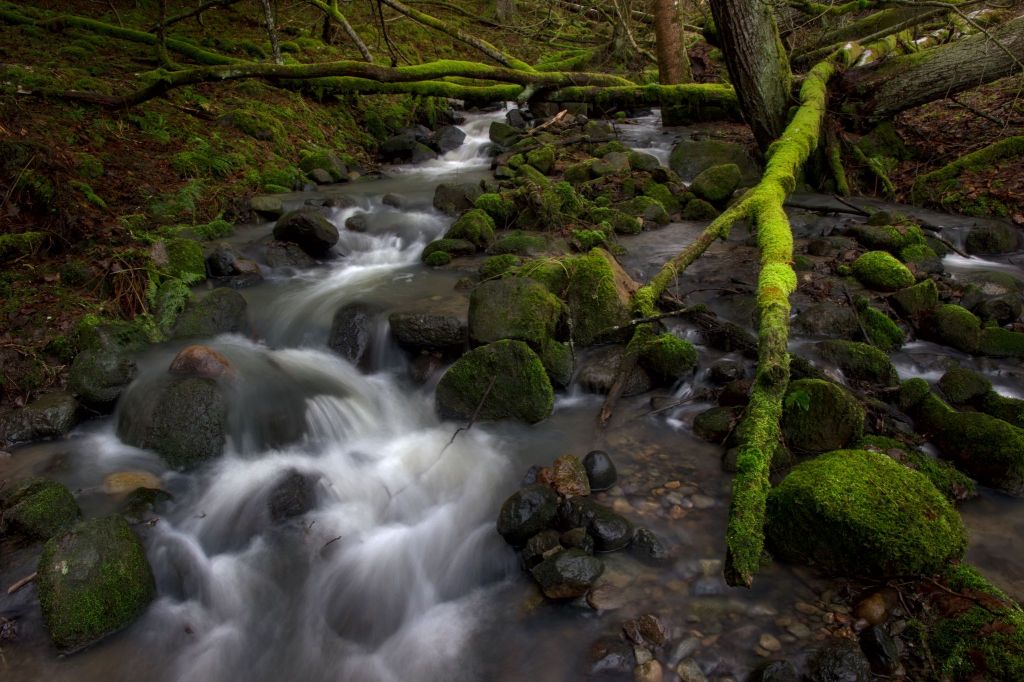
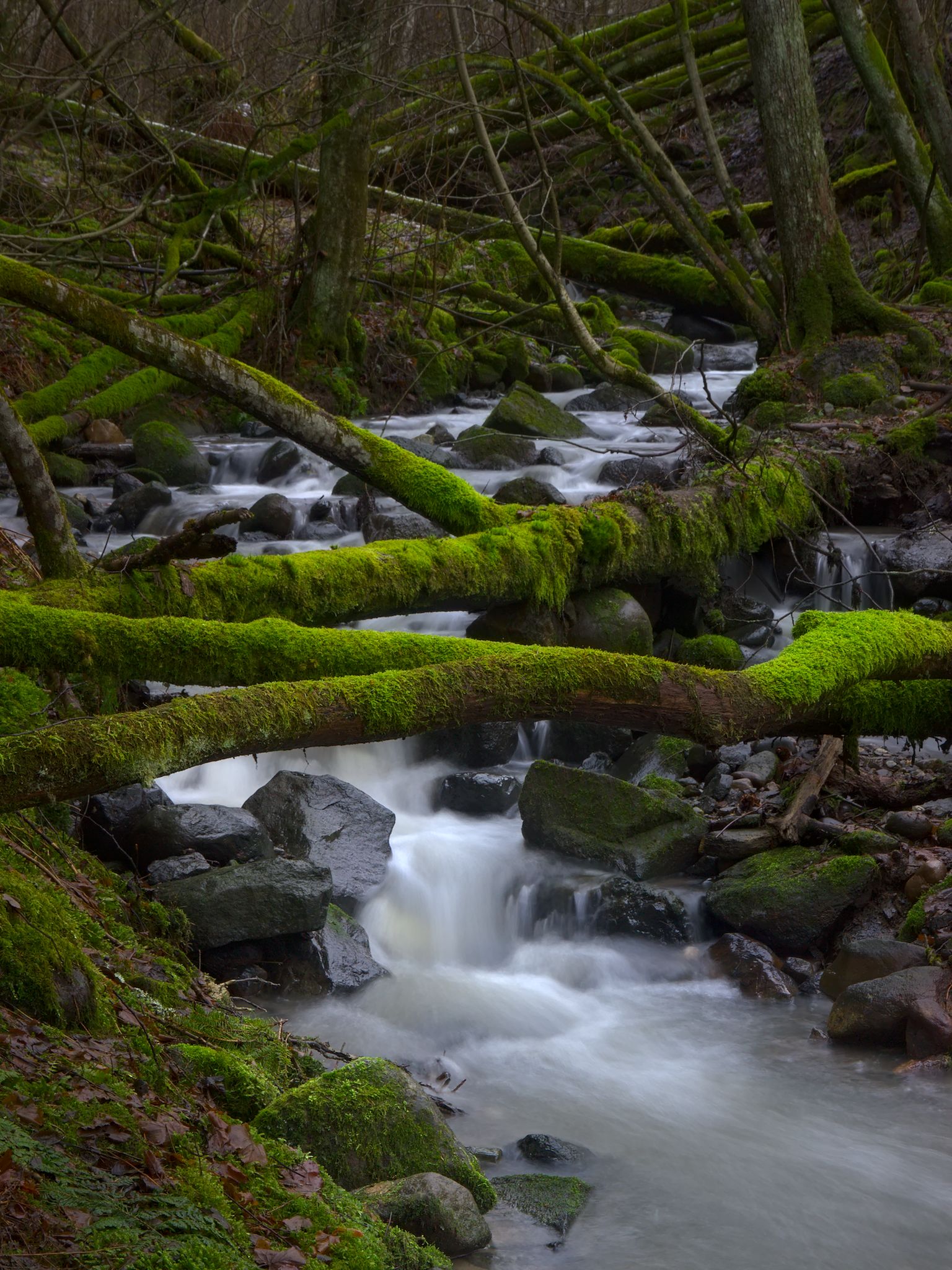
There is this little valley with a stream running through it. The stream is eroding the banks, and trees growing along the stream sooner or later loos their foothold and fall over. The trees are left to themselves, crisscrossing the stream, and this creates interesting patterns and lines. By taking care to leave the sky out, I am left with a certain minimalism in the chaos, where the compositions are dominated by the white water and mossy, green tree trunks.
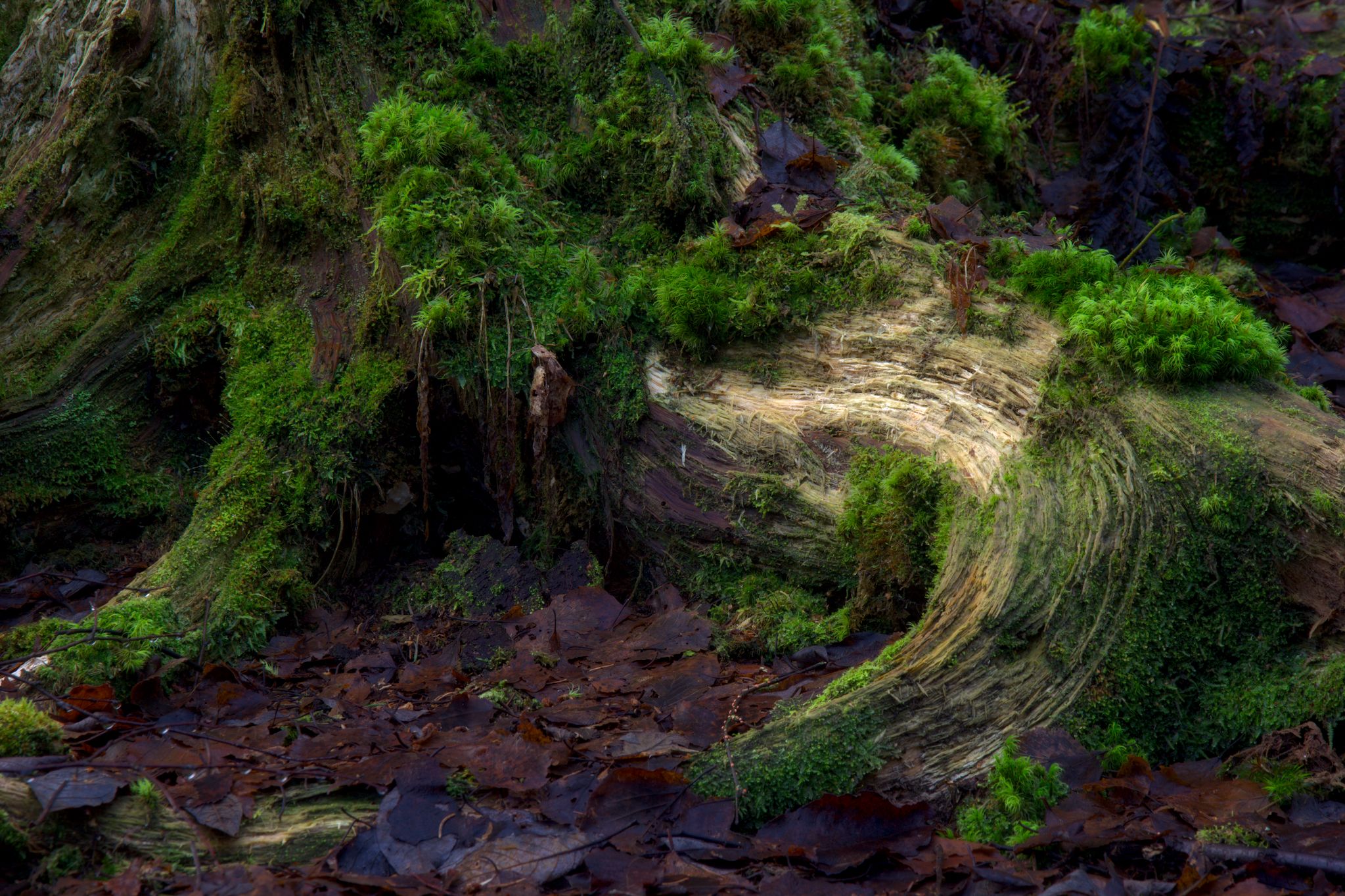
I also have a certain fascination for old, rotting tree stumps. They often contain a fantasy world of their own, with miniature landscapes and interesting shapes. If I find the right one, I can spend hours exploring it.
I found this one on my way back to the car. I had packed my gear, but I couldn’t resist. I especially love roots that are creeping out above ground.
I circled it for a while, trying to reveal its secrets. Then I noticed an animal’s legs:
So what is your winter like? Is it like it should be in your part of the world, or is it like here, more like two or three months later? We should have a whole lot of snow and temperatures well below freezing, instead we’ve got this.
I’d love it if you check back soon for more, I promise to make more content in the future than I have done lately.
If you haven’t read Part 1, please go ahead and do so here.
When I packed up and left the location of my sunset shoot, I had this idea that I might get the chance to do some star photography during the darkest hours of the night. But as the night progressed and I was awake quite a lot of times (if I ever really slept in the first place), I saw that it never became dark enough. At the most I could see a handful of stars, so there was no point in getting out and trying.
Around 4 am, I drove back to where I was the night before, and I set up at the same spot. I wanted to get the first sunlight on Bitihorn, and also a shot of Bygdin and the distant mountains behind it. A sunrise was right around 5 am, I had plenty of time to find my compositions. Unfortunately, there were no clouds, only a quite hazy, cloudless sky. Therefore I needed to include more ground than sky. I settled on two compositions of Bitihorn, one quite wide and one more tight.
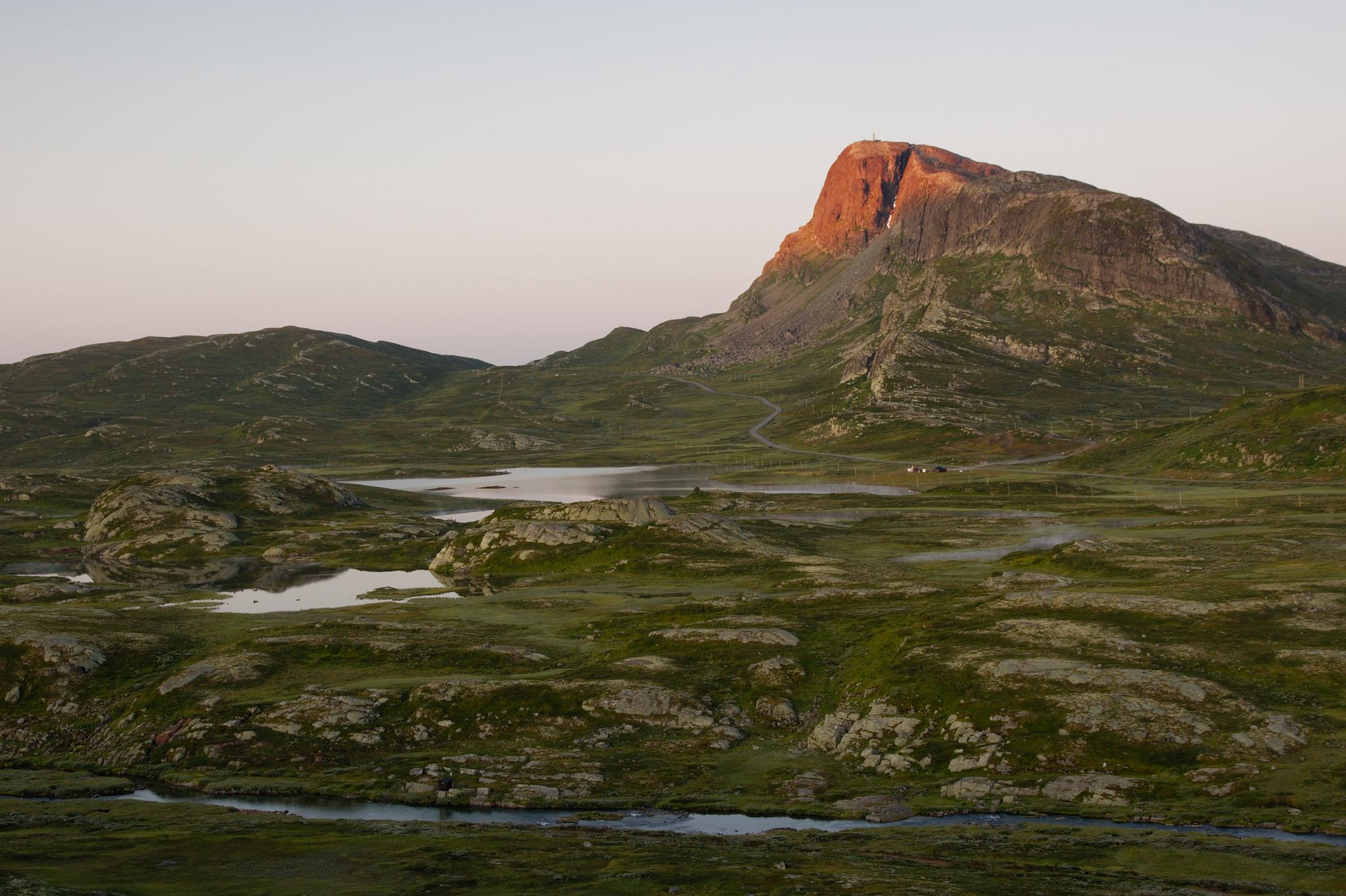
I could not see the sun directly from my position, so as the sun rose, I had to take several shots just in case the light would be blocked by a cloud just at the right moment. But I was lucky, the sky was just as cloudless in the North-East as it was in the South and West. In the end, these were the two keepers, one of each composition:
Bitihorn sunrise, tight version. Canon 550D, Canon EF-S 15-85 mm f/3.5-5.6 IS USM @67 mm, f/8, 1/5 s, ISO 100
Bitihorn sunrise, wide version. Canon 550D, Canon EF-S 15-85 mm f/3.5-5.6 IS USM @28 mm, f/8, 1/5 s, ISO 100
Which one do you like the most? Let me know in the comments. I’d also like to know which one is your favourite from my sunset shoot the evening before.
I also had a nice view of Bygdin to the West from this same spot. I just had to turn 90º to my right and adjust the focal length to get this:
Sunrise over Bygdin. Canon 550D, Canon EF-S 15-85 mm f/3.5-5.6 IS USM @76 mm, f/8, 1/4 s, ISO 100
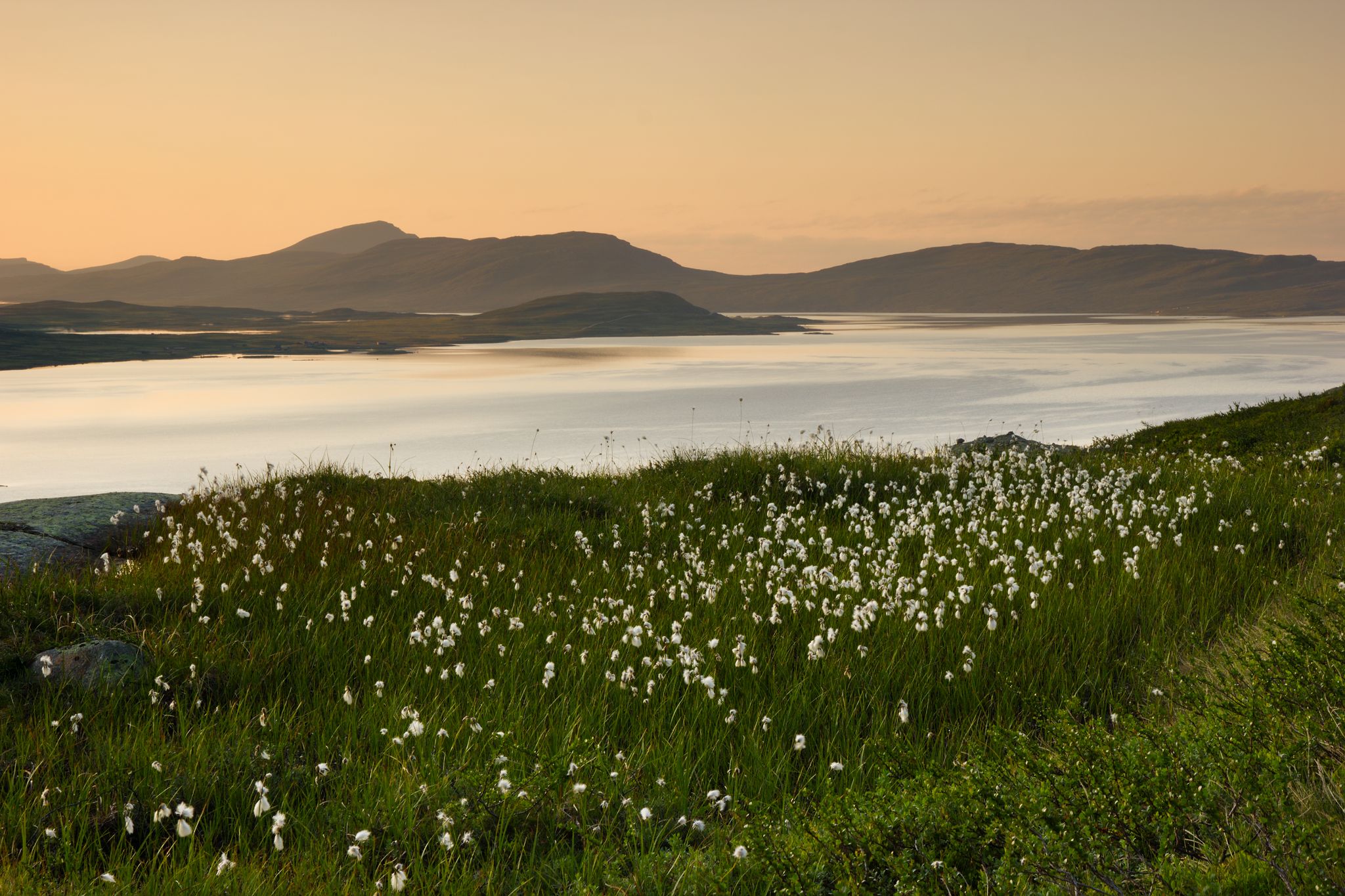
With a nice sunrise in the can, it was time to break up and head home. On my way back to the car I came by a small field of cotton-grass (Eriophorum), backlit by the morning light. I just had to get that too.
Cotton-grass. Canon 550D, Canon EF-S 15-85 mm f/3.5-5.6 IS USM @42 mm, f/14, 1/6 s, ISO 100, focus stack.
For this to work, I needed the whole image to be sharp from front to back. With a focal length of 42 mm that is not possible in one shot, so I focus stacked two images, one with focus on the cotton-grass and one with focus on the background. I also normally don’t want an aperture smaller than f/14.
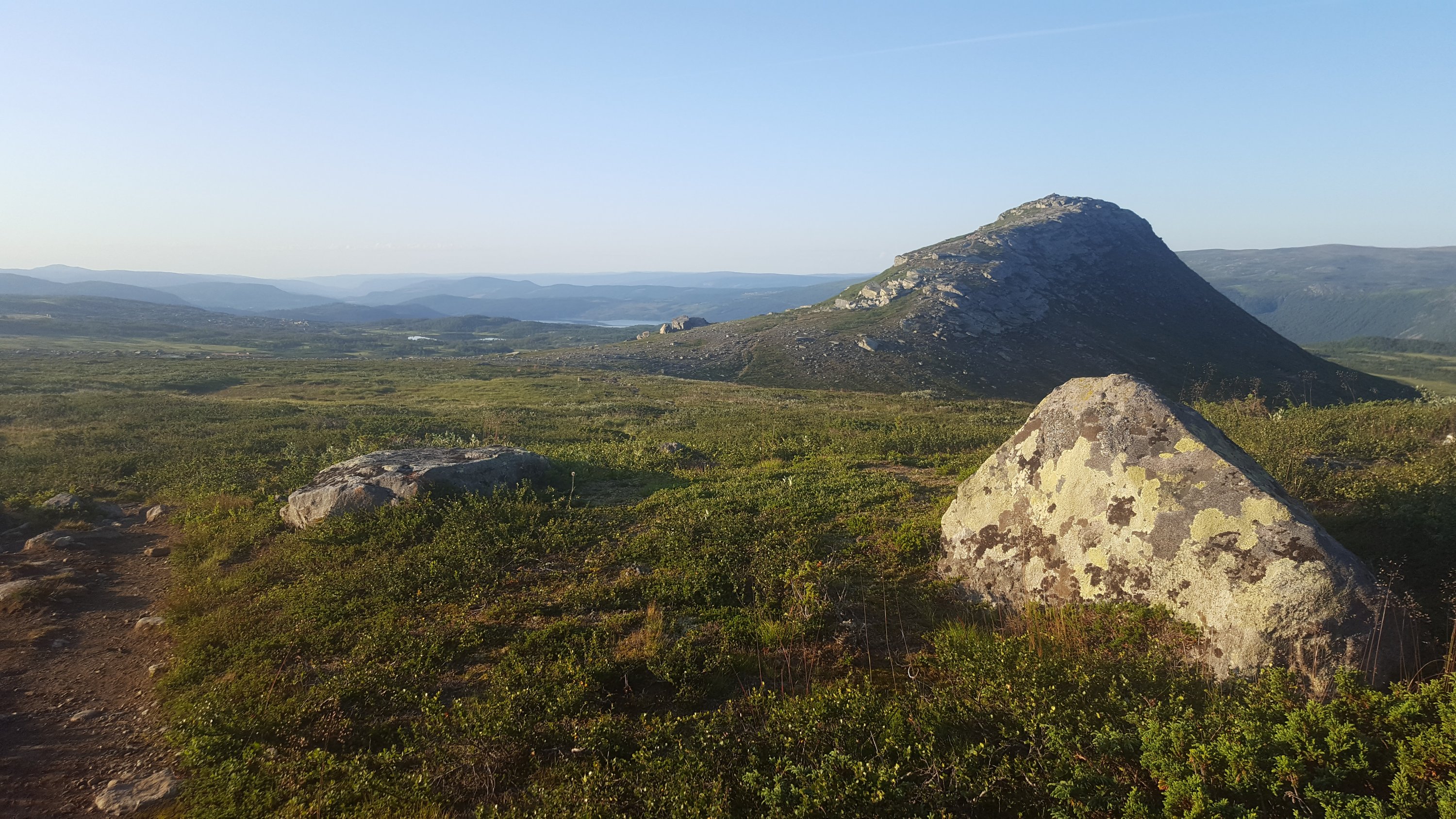
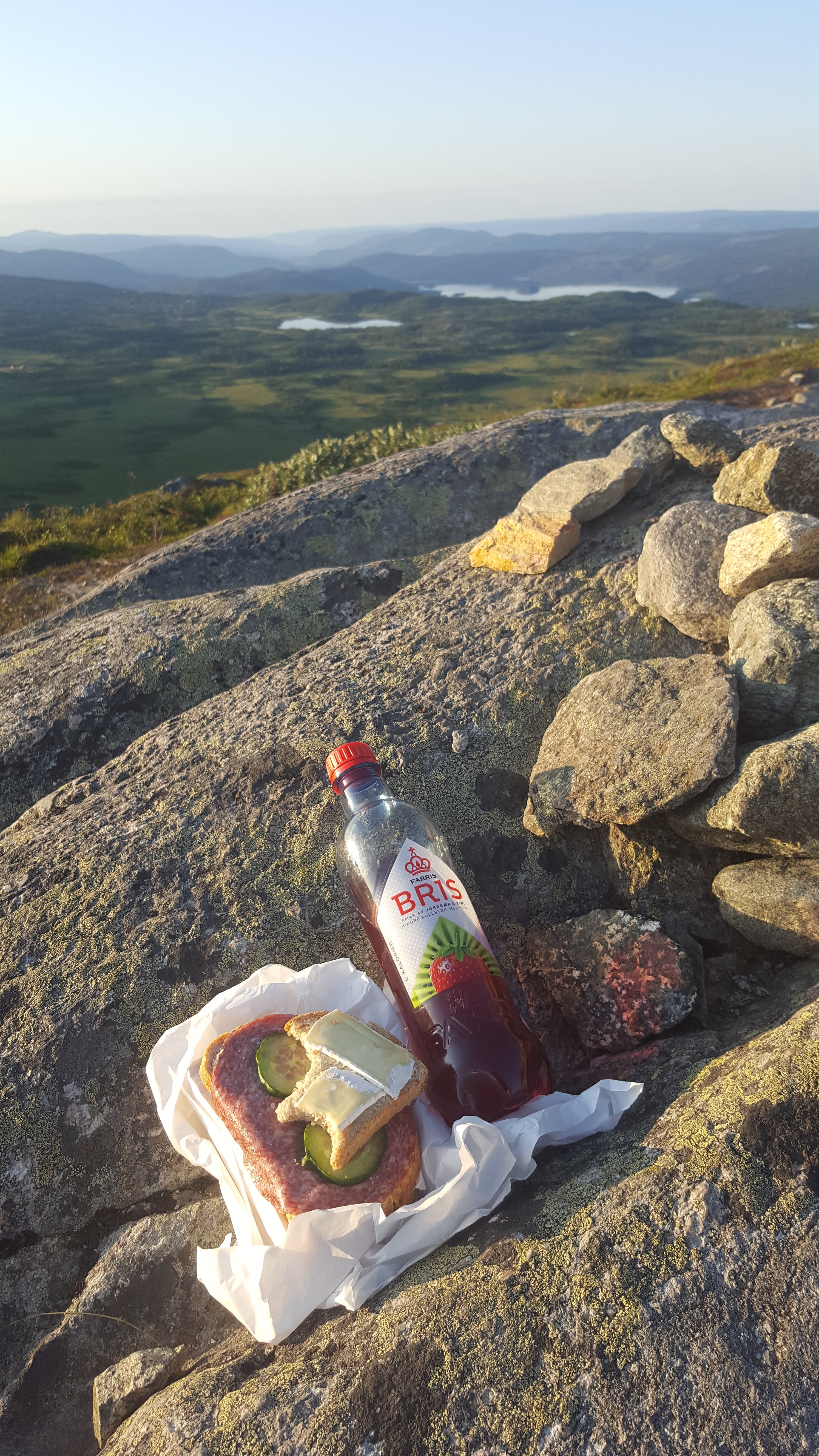
By now I started to feel the need for some breakfast. I went back to the car and started on my way home, intending to find somewhere to eat in the morning sun. Just past Bitihorn and Båtskaret, I found what I was looking for. A small peak in the open landscape, just a couple of hundred meters from the road, and with a parking space nearby, was bathing in sunlight. I took my breakfast and climbed to the top.
With Bitihorn behind me and the valley of Øystre Slidre spreading out in front of me, I enjoyed one of the best breakfasts I had had in a long time.
This summer I had a few days to my self at our cabin in Valdres, Norway. One day I decided to drive to Valdresflya, which is a mountain area just outside Jotunheimen National Park. I wanted to spend the night there, so I could get both the sunset and the following sunrise. I also wanted to sleep in my car. That was not very comfortable, but it made it easy to get up for sunrise.
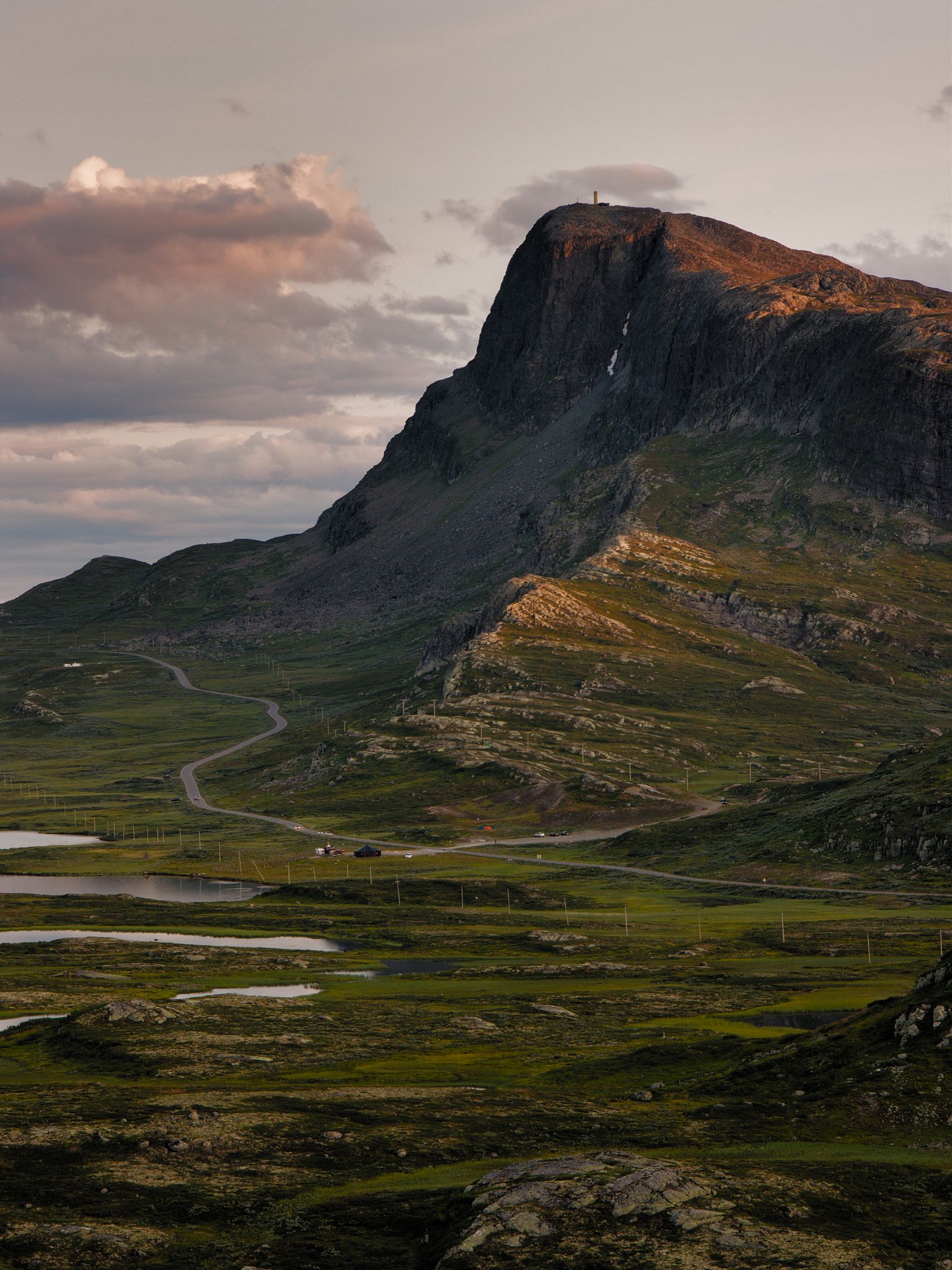
So I drove north towards the sinking evening sun. My goal was to photograph a mountain called Bitihorn, which lies as a watch post at the entrance of Valdresflya, just where the road passes through Båtskaret (Boat Pass). Nearby is also the lake Bygdin, with a hotel by the shore, another potential photo location.
Just before the hotel, there was something holding up the traffic. It turned out to be a herd of cows on their way home for the evening, longing to get milked.
Cows passing Bygdin Hotel, with Bitihorn in the background.
Just after passing the cows, I noticed a low ridge to the right of the road. I thought it would provide good views of both Bygdin and Bitihorn, so I found a place to park the car, put on some extra clothes, grabbed my camera bag and went for a short hike up the ridge.
I noticed an area with some nice yellow flowers covering the ground. In the background, Bygdin was stretching out into the distant mountains. Some nice, puffy clouds were just starting to catch colour from the setting sun, even though it still was an hour until actual sunset. This scene called for a wide angle shot with lots of depth of field. I set up my camera with the Sigma 10-20 mm f/3.5 at 14 mm focal length and an aperture of f/11. This meant I needed an exposure time of 1/10 s for the foreground. I’m not too good at remembering which graduated filters I end up using, but I think I ended up with my 4-stop hard edge filter to darken down the sky.
Flowers in front of Bygdin. Canon 550D, Sigma 10-20 mm f/3.5 @14 mm, f/11, 1/10 s, ISO 100, 4-stop hard grad.
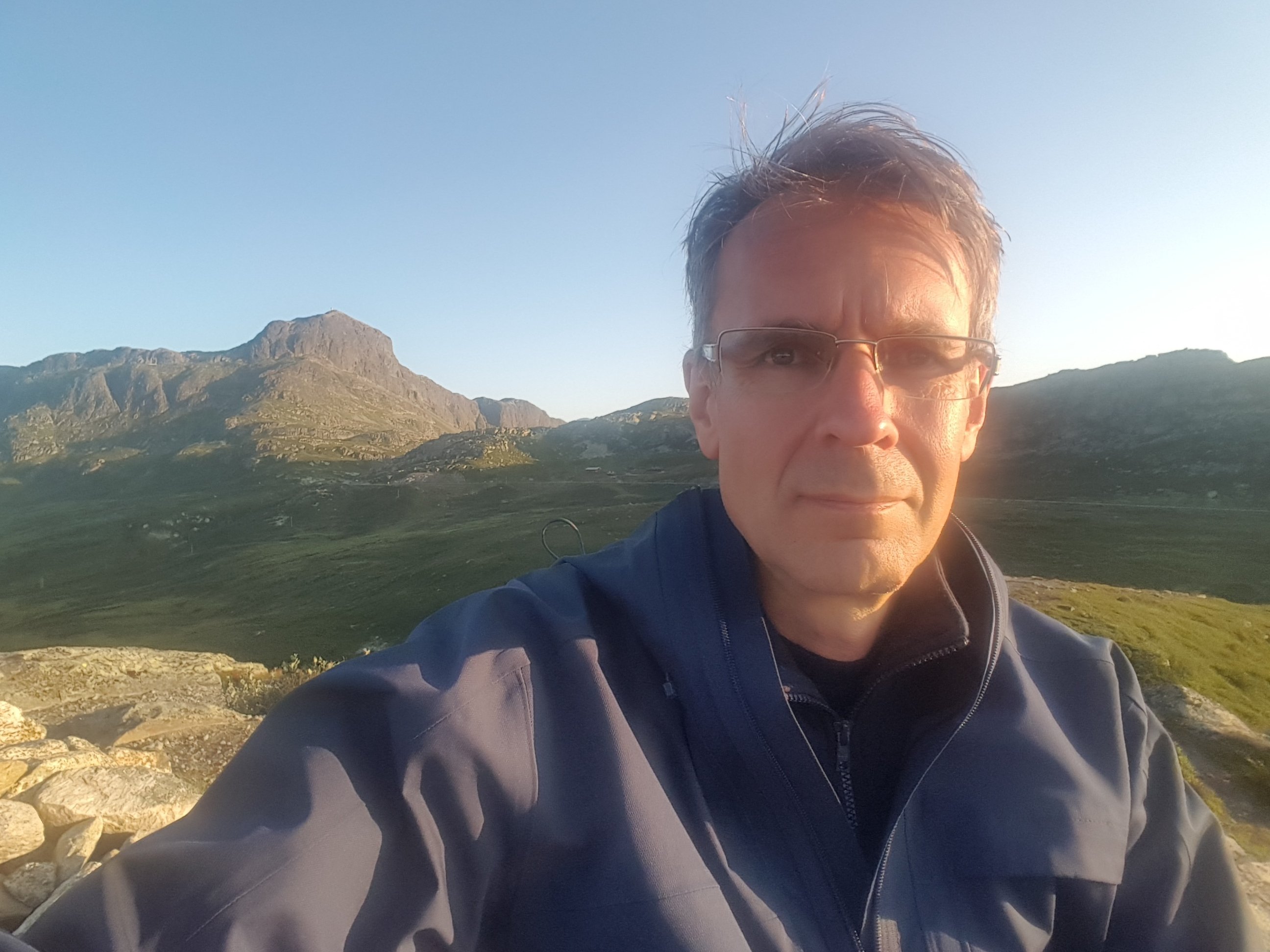
With this first «serious» photo of the trip done, it was time to prepare for the sunset photo of Bitihorn. I found a position with a good view to the south, and sheltered from the cool wind that was starting to pick up from the north. There were also several possible compositions, both wide and more close. I switched to my standard lens, the Canon EF-S 15-85 mm. While waiting for the light, I used the 10 second timer to take a selfie.
Selfie in front of Bitihorn. Canon 550D, Sigma 10-20 mm f/3.5 @20 mm, f/11, 1/10 s, ISO 100.
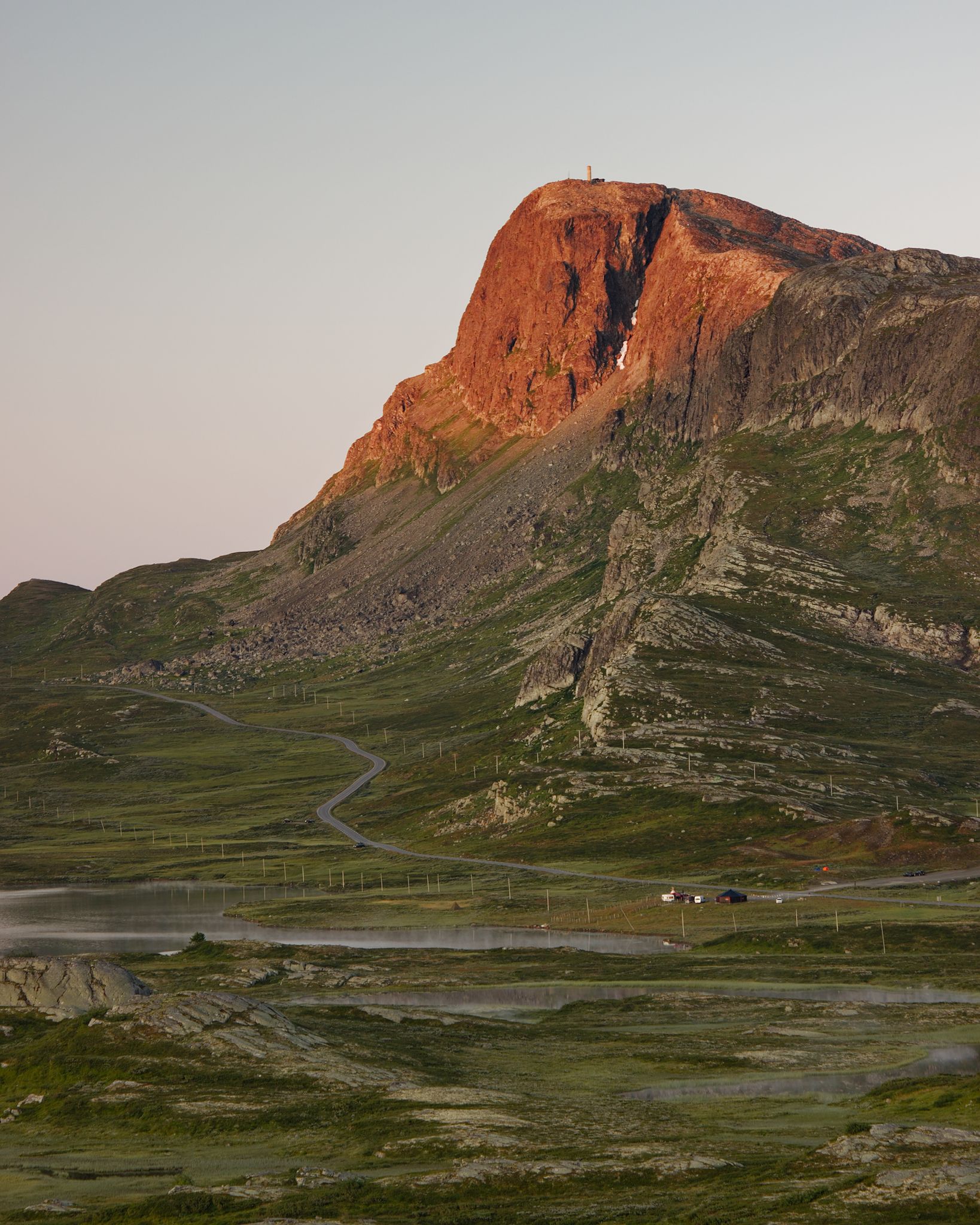
I knew that at the time of sunset, at around 10 pm, the sun would be blocked by the taller mountains of Jotunheimen, so my last chance of sunlight hitting Bitihorn would be some time before that. I wanted the last light hitting the top, and as much of the mountain as possible, so I watched closely, taking a photo whenever there was some sunlight. In the end, when the light finally hit the mountain top for a few minutes, there was no light anywhere else. I had another shot that I took a few minutes earlier, with sunlight hitting a small ridge at the foot of the mountain. In the final image I blended in a bit of this one to get the effect that I wanted. I used no filters on this one, but I bracketed with two stops on either side to get both the bright sky and clouds and the shadowed side of the mountain well exposed.
Last sunlight on Bitihorn. Canon 550D, Canon EF-S 15-85 mm f/3.5-5.6 IS USM @50 mm, f/11, bracketed composite.
It was such a beautiful night, and I was really enjoying the solitude and the quietness. There was a small river flowing by beneath me, providing the sound track. I could not hear cars passing on the road, only the occasional motorcycle. While I was sitting there and the light faded away I found myself thinking about life, the universe and everything, and as always, the answer was 42.
Jokes aside. From time to time a car passed on the road. There wasn’t much traffic, but a few minutes between each. And the way the road winded along the foot of Bitihorn gave me an idea for another photo. A long exposure with light trails. I put on a 2-stop grad to hold back what was left of light in the sky, and also a 6-stop ND to get long exposure times while it was still not very dark. Since the cars were so few and far between, I would need to follow one car the whole way, and that meant an exposure time of about two minutes. I also chose an aperture of f/8 for maximum sharpness. I don’t remember now if I used the 6-stop on the final image, but the graduated filter is there. I’m not quite sure it was necessary in the end, though.
The Diamond Necklace. Canon 550D, Canon EF-S 15-85 mm f/3.5-5.6 IS USM @65 mm, f/8, 121 s, ISO 100
I like this image very much, I think it is my favourite from this trip. The light trail reminds me of a diamond necklace, framing the peak of Bitihorn.
By now it was almost getting dark. There was just enough light to find my way back to the car. I drove a few kilometers further, then I found a parking lot and tried to get a few hours of rest before sunrise.
If you have been with me so far, then please stay tuned for Part 2, about the following morning’s sunrise shoot.
In part 1 of the preferences videos I went through the GUI options tab of the preferences dialog in darktable. If you haven’t watched it, I recommend you take a look here.
In part 2 of the series I go through the rest of the options, divided into four more tabs: Core options, Session options, Shortcuts and Presets.
Core options
These options are all about controlling the inner workings of Darktable. Memory management, color management of thumbnails and how to store thumbnails are only a small part of it. There are also options for image quality, the handling of sidecar files, choose to enable OpenCL for faster rendering using your GPU or not and other options.
Session options
These options control how darktable sets up the folder structure and renames files when you import images from a camera or taking photos via tethering. If you set up a good system here, you don’t have to worry about where to place your images, it is all taken care of for you. You can use a series of predefined variables or your own names, or a combination of those.
Shortcuts
Here you will find all the keyboard shortcuts Darktable uses. You can also customize them to suit your taste and build your own personal set of shortcuts. Complete sets of shortcuts can be exported to a file for backup and can also easily be imported.
Presets
Just like with the shortscuts, here is a collection of all your presets from all the modules. The presets that come with Darktable as default can not be altered in any way, but you can manage the ones you have made yourself. Change the name, save them as separate files or set them to be applied automatically to matching images or to only be visible for matching images. You can also set the criteria for matching, and you can import presets.
After a few weeks of nothing, I have finally made a new Darktable video. This time all about adjusting the tonal values of an image. This is part one of two covering this topic. In this part I mostly show what the different modules do on a greyscale black to white gradient. This is a great way to visualize how a tool actually works. In part two I will revisit some of the modules to show their use on real images.
I was planning to announce all my Darktable videos with a blog post, but so far I have only done it twice. But here is episode 8, about some of the modules in Lighttable mode. The modules I cover in this video is Select, Selected Image(s), History Stack and Styles.
There’s a lot you can do with the selected images in Lighttable, and the juggling of history stacks is really powerful. So go ahead and watch the video, and if you have questions, just let me know in the comments.
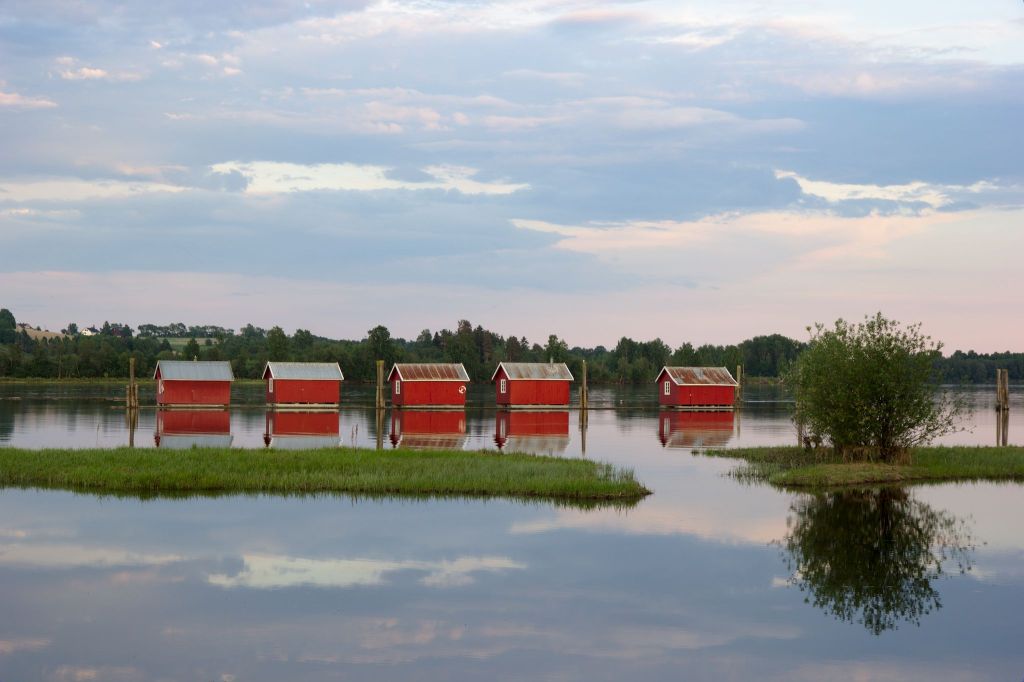
On the evening of one of the immensely hot days we have had here in Norway lately, I took a trip to Fetsund and the timber booms museum there. I have been there once before, a few years ago. There were some nice clouds in the sky so I had hopes for a few good sunset photos.
The sun was low in the sky, there was not a breath of wind, and the air was still quite hot at 10 pm. Therefore I was still in t-shirt and shorts, which I would soon regret. I parked my car at the Visitor Centre Wetland and walked down the walkway along the water to look for a photo location. I found the spot where I took the photos in this post, but the place was guarded by an army of mosquitoes. Even though I had taken care to use a quite effective mosquito repellent, they attacked me in vast numbers, driving me back to the car. For five minutes I just sat there, killing mosquitoes that had come in with me one by one.
I then drove back to the main parking area of the museum and took a stroll around to look for other photo spots. I didn’t really find anything, so I put on some other clothes and went back to where I’d been before. This time I had better protection, but the attackers were still at it. I quickly put up my tripod and found these two compositions as the last hint of sun swept across the landscape.
If you take your photos in RAW format (which I think you should) then you need a piece of software to develop your RAW files into beautiful images. And what is better than using free software? No investment, no monthly fees, and a large, helpful community for support. Even get directly in touch with the developers.
My favourite RAW developer is called Darktable. It started out some years ago only running on Linux. Eventually it was ported to OS X, and this winter the Windows version came out.
Darktable is a very capable free alternative to Adobe Lightroom and others. Like Lightroom it can be used not only to edit your photos, but also to import them from your camera, organize them and print them. As Lightroom is the only commercial RAW developer I have any knowledge about, I’ll use it as a reference.
The two are quite different in the way you work with them. This may make the learning curve of Lightroom a bit easier in the beginning, but I think in the end Darktable is more powerful and more flexible. Many tasks can be done in multiple ways, giving better results under different circumstances.
If you are curious and would like to learn about Darktable, I have just started a YouTube channel about it. The two first videos are out, and I plan to release a new episode every Sunday. See the first episode here:
I’d love it if you like, comment, share and subscribe, so my channel can gain some momentum. Thank you in advance, and see you next time.













 H P Birkeland fotografi